
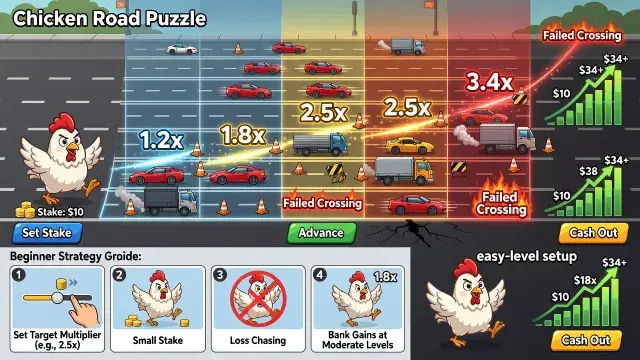
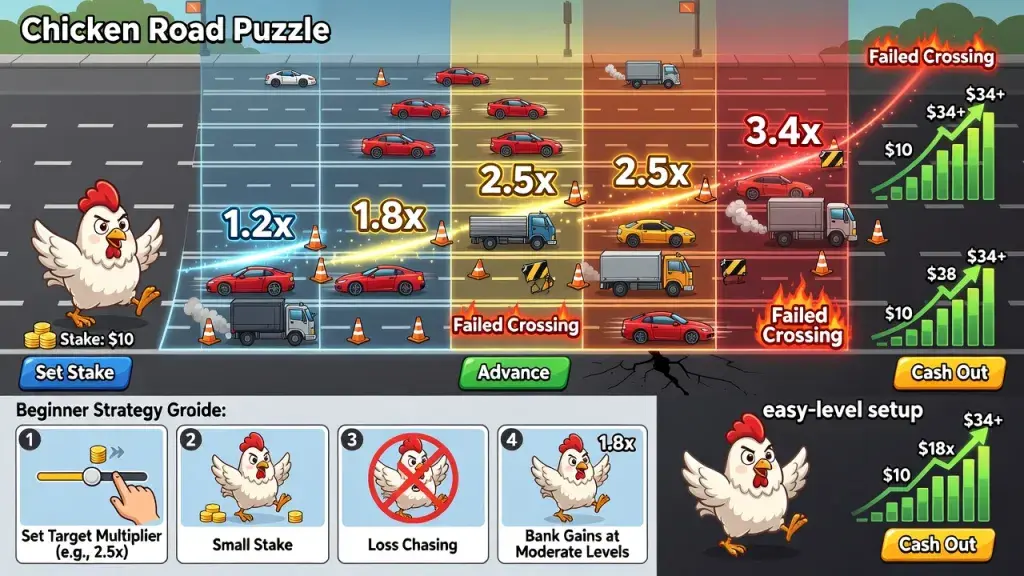
A single wrong step ends the round instantly, yet the payout multiplier keeps climbing the longer you survive. That tension - greed against caution - is the entire engine behind the chicken road puzzle, and it explains why so many players get hooked after just one attempt. The game looks simple on the surface: a chicken crossing a road, lanes to clear, a multiplier that grows with each successful move. But the decision-making underneath is sharper than it first appears, and beginners who rush in without understanding the mechanics tend to burn through their first few rounds fast.
This piece breaks down exactly how the game works, what separates a calculated move from a reckless one, and how to build a repeatable approach instead of relying on luck alone. If you want a structured breakdown before diving in, the official chicken road game for beginners walkthrough covers the core rules in a step-by-step format, and it pairs well with the strategic reasoning we'll get into here. Between the two, you'll have both the mechanical basics and the thinking behind smart play.
What follows is a complete beginner chicken road guide: the rules, the risk curve, a practical strategy framework, and a walkthrough of an easy level so you can see the logic applied in real time.
What Is the Chicken Road Puzzle?
The chicken road puzzle belongs to a family of crash-style games built around a single core mechanic: incremental risk for incremental reward. A chicken moves across a road divided into lanes, and each lane cleared safely raises a multiplier applied to the player's stake. The catch is that every lane also carries a chance of failure - step wrong, and the round ends, wiping out the accumulated multiplier along with it. There's no partial credit. You either bank your winnings before the failure point or lose the run entirely.
Origins and Game Type
Games like this descend from the broader crash-game genre, where a rising value must be cashed out before an unpredictable collapse. The chicken road version reframes that same tension visually - instead of watching a line climb on a graph, you're watching a chicken hop between lanes, which makes the decision points feel more concrete and easier to track for new players.
Why It Appeals to Beginners
Part of the appeal is how quickly the rules can be understood. There's no card counting, no complex paytable, no memorization of symbol combinations. You watch the multiplier, you decide whether to continue or cash out, and the round resolves in seconds. That simplicity is exactly why a solid beginner chicken road guide matters - the rules are easy to grasp, but the decision-making underneath rewards a bit of structure.
Core Objective
The objective is straightforward: survive as many lanes as possible while cashing out before the odds catch up with you. Every lane you clear increases your potential payout, but it also increases the cumulative probability that the next step ends the round. Understanding that trade-off is the single most important concept in the entire game.
Chicken Road Game How to Play: Step-by-Step Basics
Before any strategy makes sense, you need the mechanical sequence down cold. The game unfolds in a fixed pattern, and knowing what happens at each stage removes the guesswork that trips up first-time players.
Setting Your Stake
Every round starts with a bet placed before the chicken begins moving. This amount is fixed for the duration of that round - you can't add to it mid-game, so deciding your stake size upfront is part of the strategic layer, not just a formality.
Starting the Crossing
Once the round begins, the chicken sits at the edge of the first lane. Each subsequent lane represents a discrete decision point: advance, or stop and collect. The multiplier tied to each lane is typically displayed before you commit, so you always know what you stand to gain by advancing.
Reading the Multiplier Progression
Multipliers increase with each lane cleared, but not at a flat rate. Early lanes tend to offer smaller multiplier jumps because the risk of failure is lower; later lanes offer steeper jumps because the odds of a safe crossing shrink. This escalating structure is the mathematical backbone of the entire chicken road puzzle.
Cashing Out
At any point before a failed crossing, you can cash out and lock in the current multiplier applied to your stake. This is the only way to guarantee a win - waiting too long in pursuit of a bigger multiplier is the most common way beginners lose rounds they should have banked.
- Place your stake before the round starts
- Advance lane by lane, watching the multiplier rise
- Decide after each lane: continue or cash out
- A failed crossing ends the round with no payout
- Cashing out locks in your current multiplier as a real win
Beginner Chicken Road Guide: Core Rules to Remember
Once the sequence is familiar, the next step is internalizing the rules that govern risk. These aren't optional details - they shape every decision you'll make in the game.
Risk Increases With Distance
The further the chicken travels, the higher the probability that the next lane ends the round. This isn't a flaw in the design - it's the entire point. The game is built so that greed has a natural ceiling, and recognizing where that ceiling sits for your own risk tolerance is a foundational skill.
There Is No "Safe" Late Lane
New players sometimes assume that after clearing several lanes, the danger somehow plateaus. It doesn't. Each additional lane typically carries equal or greater risk than the one before it. Treat every advance as a fresh decision, not a continuation of momentum.
The Round Is Binary
You either cash out with a win or fail with nothing. There's no partial payout for reaching a certain lane without cashing out first. This binary outcome structure is why timing your exit matters more than how far you theoretically could have gone.
Chicken Road Strategy for Beginners
With the rules and risk structure clear, the real question becomes: how do you actually play smart? Strategy here isn't about predicting outcomes - the mechanic is designed to resist that - but about managing your exposure and exit timing consistently.
Set a Target Multiplier Before You Start
Decide, before the round begins, what multiplier you're aiming to cash out at. This removes emotional decision-making in the moment, when rising numbers make it tempting to push further than planned. A fixed target is the single most effective habit for a beginner.
Use Smaller Stakes to Learn the Rhythm
Early sessions should prioritize learning the pacing of the multiplier curve over chasing large payouts. Smaller stakes let you observe how risk scales across lanes without significant loss, which builds the intuition needed for later, higher-stakes decisions.
Avoid Chasing Losses
After a failed round, the instinct to immediately recover the loss with a bigger bet is strong - and it's almost always counterproductive. The game has no memory of previous rounds; each one is an independent event. Chasing losses just compounds risk without improving your odds.
Bank Gains Incrementally
Rather than treating every round as all-or-nothing, experienced players often cash out at moderate multipliers consistently rather than gambling for the highest possible payout every time. Small, repeated wins tend to build a healthier long-term balance than occasional large ones offset by frequent failures.
Easy Chicken Road Level Walkthrough
To see the strategy in practice, it helps to walk through a simplified, low-difficulty round from start to finish. This easy chicken road level walkthrough illustrates decision points as they'd actually appear in play.
Round Setup
Assume a modest stake is placed, and the first lane offers a small multiplier increase - typical of easy-difficulty configurations designed to ease new players into the mechanic. The low early risk here is intentional; it's meant to build confidence before the stakes rise.
First Three Lanes
The opening lanes usually carry the lowest failure probability in the entire round. This is the ideal stretch to advance without hesitation, since the risk-reward ratio strongly favors continuing. A beginner following a target-multiplier strategy might set their first checkpoint here, just to confirm the pacing feels manageable.
Mid-Level Decision Point
Around the middle of an easy-level round, the multiplier growth starts to accelerate slightly, and this is where a disciplined player checks in against their pre-set target. If the target multiplier has been reached, cashing out here is the textbook move, even though the temptation to push toward a bigger number is strongest at exactly this stage.
Final Stretch and Cash-Out Timing
The last lanes of even an easy-difficulty round carry noticeably higher risk than the earlier ones. This is where beginners most often lose rounds they could have banked safely. The lesson from this walkthrough is consistent with the broader strategy: lock in gains before the risk curve outpaces your comfort level, not after.
Common Mistakes New Players Make
Even with a clear beginner chicken road guide in hand, certain mistakes show up repeatedly among first-time players. Recognizing them in advance is often enough to avoid them entirely.
Ignoring the Escalating Risk Curve
Treating every lane as equally safe leads directly to overextension. The escalating structure of the game means each advance deserves fresh evaluation, not blind continuation based on earlier success.
No Predefined Exit Point
Playing without a target multiplier turns each round into a purely emotional decision made under pressure. Setting that number in advance is a small habit that prevents the majority of avoidable losses.
Overcommitting Stake Size Early
Betting large amounts before understanding the pacing of the multiplier curve is a fast way to lose confidence and capital simultaneously. Build familiarity first, scale stakes later.
Frequently Asked Questions
Is the chicken road puzzle based on luck or skill?
The underlying outcome of each lane is randomized, so luck determines whether any single crossing succeeds. Skill comes into play through stake management, target-setting, and disciplined cash-out timing, which shape long-term results even though individual rounds remain unpredictable.
What's a reasonable multiplier target for a beginner?
A conservative target in the early-to-mid range of the multiplier scale is typically sensible for new players, since it balances meaningful payout with lower cumulative risk. As familiarity with the pacing grows, targets can be adjusted based on comfort with risk.
Does the difficulty level change the risk curve?
Yes. Easier levels generally offer a gentler risk progression, meaning the probability of failure rises more slowly across lanes compared to harder difficulty settings, which is why beginners are advised to start there.
Can previous rounds predict the outcome of the next one?
No. Each round operates independently of previous results. Adjusting your strategy based on a "streak" from earlier rounds is a common but ultimately unfounded approach.
How important is stake size to overall strategy?
Stake size directly determines the magnitude of both wins and losses, but it doesn't change the underlying probability of success at any given lane. Smaller stakes are recommended while learning, since they reduce the cost of the inevitable learning-curve mistakes.
What's the biggest difference between an easy level and a harder one?
The main difference lies in how quickly failure probability increases per lane. Easy levels stretch that curve out, giving players more lanes of relatively low risk before the danger escalates sharply, which is exactly why they're the recommended starting point for anyone new to the game.

