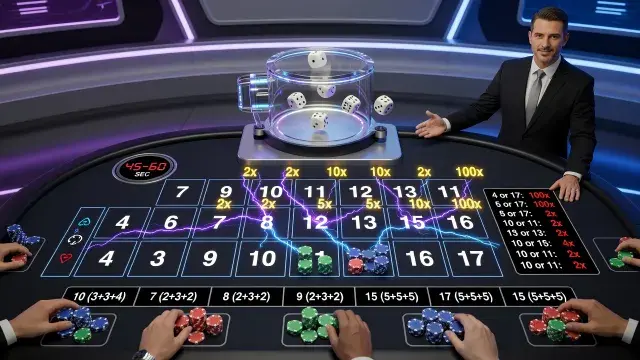

Three dice, one wheel spin, and a multiplier that can turn a modest wager into a substantial payout in seconds - that's the entire premise packed into a single round. Few casino games compress so much decision-making into so little time. A round finishes in under a minute, yet the betting choices you make before the dice settle determine whether that minute pays off or costs you.
The appeal lies in its hybrid nature. It borrows the simplicity of Sic Bo, the visual drama of a wheel-based multiplier round, and the pace of a live dealer game, then compresses all three into a format that rewards sharp observation over long sessions. Before placing real bets, many players choose to study how to play lightning dice through a demo round or a guided walkthrough - for instance, the tutorial available at how to play lightning dice breaks down the betting grid and the multiplier mechanic in a format that's easy to follow. Once the basic sequence clicks, the game opens up considerably.
What follows is a complete breakdown: the mechanics behind each round, how payouts get calculated, which betting patterns tend to hold up over time, and which habits quietly drain a bankroll. Whether you're placing your first bet or refining an existing approach, the goal here is clarity - not hype.
What Is Lightning Dice and Why It's Gaining Popularity
The Origins of the Game
Lightning Dice emerged from the live casino studio format that became popular alongside titles built around electrified multipliers - the same conceptual family that produced lightning-themed roulette and baccarat variants. The dice version strips away complexity and keeps the core appeal: a live host, a mechanical dice roller, and random multipliers that strike specific numbers before each round, inflating potential payouts well beyond standard odds.
How It Differs from Traditional Sic Bo
Traditional Sic Bo relies purely on combinations across three dice and a wide betting table. Lightning Dice narrows the scope. Instead of dozens of bet types, players wager on the total sum of three dice, ranging from 4 to 17 (3 and 18 are typically house numbers with no payout). The simplicity is deliberate - fewer options mean faster rounds and a lower barrier to entry for newcomers.
Why It Appeals to Both New and Experienced Players
The format rewards two very different play styles. Casual players enjoy the visual spectacle of the lightning strikes and the quick resolution of each round. More calculating players appreciate that the payout structure, while randomized by multipliers, still follows a mathematically consistent baseline that can be tracked and reasoned about over multiple sessions.
- Round duration typically falls between 45 and 60 seconds
- Betting numbers range from 4 through 17
- Multipliers apply to two to five random numbers each round
- Live host commentary adds context without slowing the pace
Lightning Dice Rules Explained Step by Step
Setting Up the Bet
Every round begins with a betting window, usually lasting between 10 and 15 seconds. During this window, players select one or more numbers on the board corresponding to possible dice totals. Bets can be spread across several numbers simultaneously, which changes the risk profile considerably compared to concentrating on a single outcome.
The Lightning Round Before the Dice Roll
Once betting closes, the defining feature activates: random numbers on the board get struck by lightning, each receiving a multiplier that can range from small boosts to triple-digit increases. This happens before the dice are rolled, meaning the multiplier assignment is entirely independent of the outcome - it's a separate randomized layer stacked on top of the base game.
Rolling the Dice and Determining the Outcome
A mechanical roller shakes and releases three dice inside a transparent enclosure. The total of all three determines the winning number. If that number was struck by lightning, every bet placed on it gets multiplied accordingly. If not, standard payout odds apply based on statistical probability of that total occurring.
Reading the Payout Table Correctly
Each number on the board carries a fixed base payout reflecting how likely it is to appear. Totals near the middle of the range, like 10 or 11, occur more frequently and pay less. Extreme totals, like 4 or 17, are rarer and pay significantly more even without a multiplier applied.
How to Play Lightning Dice Game: A Practical Walkthrough
Joining a Live Table
Access typically happens through a live casino lobby. Once seated at the table, the interface displays the betting board, current round timer, recent history of past results, and the live video feed of the dice roller and host.
Placing Your First Bets
New players should start by observing a few rounds before committing money. Watching how multipliers get distributed and how quickly rounds resolve helps calibrate expectations. When ready, selecting a bet amount and clicking on one or several numbers confirms the wager before the timer expires.
Understanding the Interface and Live Feed
The visual layout usually separates the betting grid from the results history bar. This history isn't predictive - dice rolls are independent events - but many players use it to track which numbers have or haven't received multipliers recently, informing pattern-based betting even though outcomes remain random each round.
Common Mistakes First-Time Players Make
New players frequently overextend by betting on too many numbers at once, diluting potential returns. Others chase multipliers that struck previous rounds, assuming a pattern that doesn't exist in a game governed by independent random events each time.
Lightning Dice Scoring: How Payouts and Multipliers Work
Base Payout Structure Explained
Lightning Dice scoring follows the statistical distribution of three-dice totals. Because there are 216 possible combinations across three six-sided dice, some totals occur far more often than others. A total of 10 or 11, for example, has far more combinations that produce it than a total of 4 or 17, which explains the payout disparity.
How Lightning Multipliers Stack With Base Odds
When a multiplier strikes a number you've bet on, it applies on top of the base payout rather than replacing it. A number with modest standard odds can suddenly become the round's biggest winner if a high multiplier lands on it and the dice cooperate. This dual-layer scoring system is what separates this format from flat-odds dice games.
Calculating Potential Returns Before Betting
Experienced players mentally calculate expected value by weighing the probability of a number hitting against its current multiplier status. A number with a 100x multiplier but low probability of appearing carries different risk than a frequently occurring number with no multiplier at all.
- Low-probability totals (4, 17) offer higher base payouts
- Mid-range totals (9, 10, 11, 12) hit more often but pay less
- Multipliers can appear on any number regardless of its natural odds
- Payouts combine base odds and multiplier value multiplicatively
Lightning Dice Strategy: Approaches That Actually Work
Balancing Coverage and Concentration
One core strategic tension defines this game: spreading bets across many numbers increases the chance of hitting something, but dilutes the payout when you do. Concentrating on fewer numbers increases variance but raises potential returns when a multiplier lands favorably. Neither approach is universally correct - it depends on bankroll size and risk tolerance.
Betting on Extremes vs. the Middle
Some players favor betting exclusively on statistically rare totals like 4, 5, 16, or 17, reasoning that the higher base payout combined with even a modest multiplier produces outsized returns relative to the wager. Others prefer mid-range numbers for consistency, accepting smaller wins in exchange for more frequent ones.
Managing Bankroll Across Sessions
Because rounds move quickly, bankroll erosion can happen faster than in slower table games. Setting a fixed session limit and dividing it into per-round unit sizes prevents the temptation to increase bets after a loss, a pattern that rarely ends well statistically.
Adapting Strategy Based on Multiplier Patterns
While each round's multiplier placement is random, some players adjust their number selection round to round based on which totals have gone the longest without a multiplier strike. This isn't a guaranteed edge, since the game has no memory, but it does introduce structure into decision-making rather than relying on impulse.
Lightning Dice Tips and Tricks for Consistent Play
Watch Several Rounds Before Betting
Observing three to five rounds before placing a single wager costs nothing and reveals how the interface, timing, and multiplier distribution actually behave in real time, rather than relying on assumptions from reading rules alone.
Avoid Chasing Losses With Bigger Bets
The fast pace of this game makes it tempting to immediately recover a loss with a larger wager on the next round. This instinct, common across nearly all betting games, tends to accelerate losses rather than reverse them.
Diversify Bets Without Overextending
A practical middle ground involves betting on three to four numbers per round - enough to increase the odds of a hit without spreading the bankroll so thin that a win barely covers the loss on other numbers.
Track Results Over Multiple Sessions
Keeping a simple log of which numbers hit, which multipliers appeared, and overall session outcomes builds a personal reference point. Over time, this record helps refine which betting patterns actually suit your risk tolerance rather than relying on memory or gut feeling.
Frequently Asked Questions
Is Lightning Dice based on skill or purely luck?
The dice outcomes and multiplier placements are entirely random, so no strategy changes the underlying probability of any given roll. Skill enters through bankroll management, bet distribution, and knowing when to walk away - not through predicting results.
What's the difference between betting on one number versus several?
Betting on a single number offers higher potential payout if it hits but carries greater risk of losing the entire wager that round. Spreading bets across several numbers lowers the payout ceiling but increases the frequency of at least a partial win.
Do multipliers guarantee a win if they land on my number?
A multiplier only pays out if the dice actually total that number after the roll. Landing a multiplier on a number you've bet doesn't guarantee anything - the dice still have to cooperate.
How much should I bet per round as a beginner?
A common approach is dividing your total session budget into at least twenty to thirty equal units, betting one unit per number selected. This stretches your bankroll across enough rounds to get a realistic feel for the game's variance.
Can previous round results predict future outcomes?
No. Each dice roll is an independent event, and the mechanical roller doesn't retain any memory of past results. The results history displayed on most tables is for reference only, not for prediction.
Why do payouts vary so much between different numbers?
Payouts reflect the actual mathematical probability of each total appearing across three dice. Totals with fewer possible combinations, like 4 or 17, pay more precisely because they occur less often statistically.